
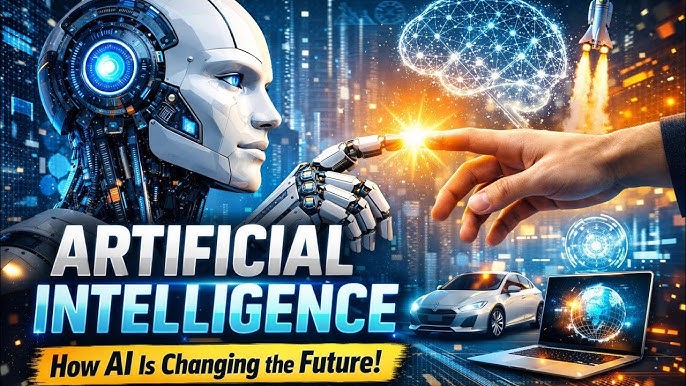
Artificial intelligence is no longer just a futuristic concept—it’s the foundational force reshaping every corner of technology in 2026. What began as experimental tools and chat assistants has evolved into autonomous systems, physical embodiments in robotics, and the backbone of enterprise infrastructure. As we stand in February 2026, AI is driving profound changes across industries, workflows, and even hardware design, accelerating innovation at an unprecedented pace while forcing organizations to adapt or risk obsolescence.
The Rise of Agentic AI: From Assistants to Autonomous Actors
One of the most transformative shifts is the emergence of agentic AI—systems that don’t just respond to queries but plan, decide, and execute multi-step tasks independently. In 2026, these AI agents are moving from hype to deployment in real-world scenarios.
Enterprises are building and managing AI agents that handle complex workflows in finance, HR, IT, customer support, and beyond. Recent developments, such as OpenAI’s Frontier platform and Snowflake’s $200M partnership embedding OpenAI models for governed, multimodal agents, illustrate how companies are turning AI into proactive digital employees. Anthropic’s Claude Opus 4.6 introduces multi-agent teams capable of dividing project tasks, expanding from coding into broader knowledge work with massive context windows and improved reasoning.
This agentic reality is creating a “silicon-based workforce,” where AI handles routine operations, allowing humans to focus on oversight, creativity, and complex judgment. As one prediction notes, companies succeeding in 2026 will rebuild operations around what AI can do best, rather than forcing automation to mimic human processes.
AI Goes Physical: Robotics and Embodied Intelligence
AI is breaking out of the digital realm and converging with robotics, enabling machines to navigate, manipulate, and interact with the physical world more intelligently. Deloitte’s Tech Trends 2026 highlights this as a core force: “AI goes physical,” with advancements in embodied AI driving autonomous mobility, logistics, and manufacturing.
Expect robots powered by advanced world models—simulating real-world consequences of actions—to become more capable, reshaping cities through self-driving transport and smart factories. This convergence promises efficiency gains but also raises questions about safety, ethics, and workforce impacts.
Infrastructure Reckoning and Efficiency Revolution
The explosive growth of AI has triggered an infrastructure reckoning. Massive investments in compute power face new economic realities around inference costs (running models after training). 2026 sees a shift toward optimized strategies: specialized chips, analog inference, chiplet designs, and even quantum-assisted optimizers.
Small Language Models (SLMs) and efficient architectures are gaining traction, delivering powerful results with far less energy than giant LLMs. Cloud is evolving into “Cloud 3.0,” with hybrid, multi-cloud, and sovereign setups tailored for AI scalability. AI is becoming the new operating system, where models access tools autonomously and software “self-assembles” based on expressed intent rather than manual coding.
Reshaping Work, Software, and Discovery
AI is fundamentally altering how technology is built and used:
- Software development moves from writing code to expressing outcomes, with AI handling integration and maintenance—”vibe coding” and intent-based programming.
- Scientific research accelerates dramatically, as AI joins the discovery process in physics, chemistry, biology, and materials science.
- Workforce dynamics face disruption: AI agents drive job displacement in areas like customer support, while creating demand for “change fitness”—organizations’ ability to adapt workflows around AI platforms.
Multimodal AI (handling text, images, video, and more) and stronger virtual assistants are embedding deeper into daily life and business.
Challenges and the Path Forward
While the potential is immense, 2026 brings sobering realities. Some analysts predict an AI “bubble” deflation, with economic ripple effects from overhyped investments. Trust, governance, security, and ethical issues remain critical—especially as AI becomes central to cyber defense and decision-making. Geopolitical tensions around tech sovereignty add complexity to global supply chains.
Yet the consensus is clear: AI innovation isn’t slowing. As IBM experts note, the pace is only accelerating. Organizations building AI-native structures, investing in people alongside tech, and balancing trade-offs will lead.
In 2026, AI isn’t changing the future of technology—it’s becoming the future. The question is no longer if AI will transform everything, but how quickly we adapt to a world where intelligence, both human and artificial, collaborates at every level. The next few years will determine whether this convergence unlocks unprecedented prosperity or demands entirely new social and economic frameworks. One thing is certain: the only constants are AI and change.